
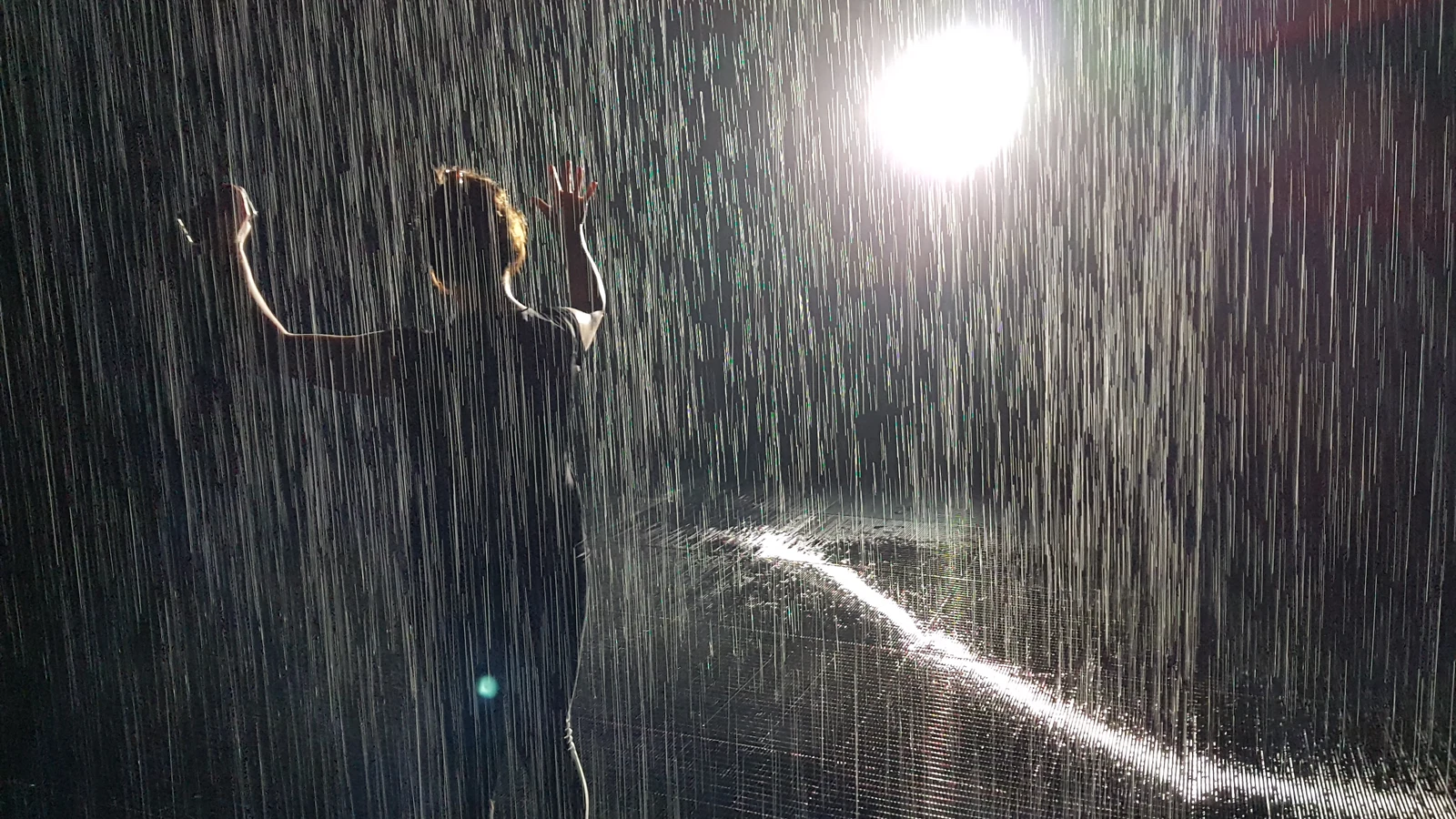
Rain Room is an unusual cultural visit because its value depends on what you do with a short period of attention. A photograph can show a person standing inside illuminated rain. It cannot reproduce the decision to take the next step, the sound surrounding the body or the moment when confidence in a responsive system replaces the instinct to avoid water.
Sharjah Art Foundation permanently houses Random International’s installation in Al Majarrah. The work dates from 2012; the Sharjah venue opened in May 2018. Its immediate proposition is a downpour that responds to detected human presence. This is an artwork involving technology, rather than a weather demonstration or a guarantee that every visitor will remain completely dry. [1]
This guide separates the verified booking conditions from an editorial method for experiencing the work. Operational information was checked on 8 November 2026. A published timetable does not establish that a particular session remains available.
Understand what you are booking
The Foundation lists sessions lasting 15 minutes, with no more than seven people entering together. Published regular hours are Saturday–Thursday, 9am–9pm, and Friday, 4pm–10pm. Separate Ramadan hours appear on the venue page; do not apply those seasonal hours to an ordinary November visit. [1]
The duration changes the planning problem. Rain Room is not an attraction to enter whenever a shopping trip leaves a spare moment. The meaningful unit is the reserved session. Travel, finding the entrance and settling a hesitant child all happen outside that artistic encounter.
Use the official booking calendar to choose the actual date and time. The booking system can display maintenance unavailability; it also states that tickets cannot be refunded, exchanged or used for re-entry. Keep the confirmation accessible before leaving your accommodation. [2]
A sensible sequence is to decide who is attending, check whether everyone is comfortable with darkness and falling water, then reserve the session. Buying first and negotiating the group’s expectations in the entrance queue creates avoidable pressure.
Match the ticket category to the visitor
The following prices were displayed in the Foundation’s booking system at the source check. Confirm the amount and category at checkout, particularly when booking for a concession or a group. [2]
| Visitor category | Displayed ticket price | Preparation before booking |
|---|---|---|
| Adult | AED 25 | Choose the specific session |
| Student | AED 15 | Bring the student ID; venue information specifies students up to 22 |
| Teacher | AED 15 | Bring evidence supporting the category |
| Child aged five or younger | Free | Include the child in the booking and supervision plan |
| Visitor with a disability and one companion | Free | Confirm documentation and any assistance directly |
The ticket conditions require booking proof and documents supporting reduced-price or complimentary admission. Prices include VAT. An unused timed ticket is not refundable, and changing to another date or time is not permitted under the published conditions. [3]
For a hypothetical family of two adults and one qualifying student, the displayed admission total is AED 65. That calculation is an illustration using the listed categories, not a promise that the desired session has three available places. Transport and other activities belong in a separate budget.
Prepare clothing, movement and expectations
The installation’s conditions prohibit pointed high heels, umbrellas and other rain gear. They warn that dark, shiny, reflective or impermeable clothes may interfere with sensing, and that sudden movement can result in some contact with water. Food and drink are not permitted inside; children require supervision. [3]
The practical response is straightforward: choose comfortable clothing and stable footwear, leave unnecessary belongings out of the experience and listen to the attendant. Do not turn the warning about sensors into a rigid fashion rule invented by an online guide. If a garment is essential for personal or religious reasons, ask the Foundation how to prepare rather than guessing.
For a child, describe what will happen without promising an impossible outcome: the room is dark, there is real falling water and the group will move carefully. Give the child permission to express discomfort. An adult’s investment in the booking should not become an instruction to ignore distress.
Visitors with sensory or mobility considerations should discuss the actual journey with the venue: entrance, transition into darkness, standing or moving during the session and the exit. A complimentary category confirms a ticket policy; it does not by itself answer every access question.
Use the first moments to observe before performing
The following is an editorial approach, not an instruction issued by the operator. Begin by noticing the space before deciding how you want to appear in a photograph. Where does the light make the falling water visible? Which sounds seem close? What changes when another visitor moves?
Then follow staff guidance and test your own pace. An interesting question is not simply whether the system detects you, but how quickly your behaviour adapts to its apparent response. People often approach unfamiliar systems by asking what they can control. A more revealing question is what the system causes them to do.
Random International describes the work through the relationship between human presence, the environment and technology. Its own account identifies a combination of water-management components, tracking cameras and custom software. [4] Those ingredients explain why the encounter can feel simultaneously physical and abstract: the water is tangible, while the rules coordinating it remain largely invisible.
Treat that interpretation as a starting point, not a required answer. Someone else in the same session may focus on vulnerability, play, shared space or the tension between a natural event and an engineered setting. The artwork can support different readings without requiring visitors to invent technical claims about its operation.
Photograph the visit without letting the camera consume it
The Foundation permits personal documentation but requires advance permission for professional photography. Its terms exclude performance or music videos, product photography and fashion shoots; mobile phones remain the owner’s responsibility. [3]
A personal ticket is therefore not permission to convert a shared session into a commercial set. If the intended use involves a brand campaign, client deliverable or organised production, obtain a clear answer from the Foundation before making arrangements.
For an ordinary visit, agree on a modest photographic plan beforehand. One person can take a few images while the other experiences the space, then swap. Avoid repeatedly asking another visitor to step aside for an imagined perfect composition. A successful photograph should be a record of the encounter, not the reason everyone else loses theirs.
After putting the phone away, remain attentive to what the image omitted. This simple contrast is useful for families discussing digital life: the most visible evidence of an activity is often a smaller part of the experience than it appears online.
Build a manageable Sharjah cultural outing
Rain Room works well as an anchor rather than a reason to rush through several unrelated venues. Pick one companion activity according to the group’s interests: the Museum of Islamic Civilization for objects and scientific history, a current Sharjah Art Foundation exhibition for contemporary work, or the Sharjah Art Museum for a focused encounter with modern Arab art. Check that second venue’s current programme and travel time independently.
A hypothetical afternoon might begin with a reserved Rain Room session, continue with a break and end with one selected exhibition. The break is part of the plan. It creates space to compare reactions and prevents the next venue from becoming another task to complete.
Use three questions after the session: what did you expect, what did you actually notice, and what changed because another person was present? These questions produce a more specific conversation than asking whether everyone enjoyed it. Families interested in extending that kind of questioning into science can use the Sharjah Planetarium planning guide for a separate outing. A child’s answer can be a sound or sensation rather than an art-historical interpretation.
If the session is unavailable, avoid treating another artwork as an identical substitute. Choose a different cultural activity on its own terms and rebook Rain Room when it fits. A permanent installation still has a functioning timetable, maintenance needs and finite capacity.
Questions before reserving a Rain Room ticket
Is Rain Room a long exhibition visit?
The published installation session lasts 15 minutes. Allow separate time for arrival and preparation; do not interpret the session length as a complete door-to-door itinerary. [1]
Will I definitely stay dry?
No guide should promise that. The operator specifically warns that movement and certain clothing can affect the response, with some contact with water possible. Follow the venue’s instructions and bring only belongings you are prepared to manage responsibly. [3]
Can I use an ordinary booking for a promotional shoot?
Do not assume so. The conditions distinguish personal documentation from professional photography and prohibit several production uses. Get permission before arranging commercial work. [3]
How should I check whether the venue is operating on my date?
Start with the Foundation’s venue information and the date-specific official booking calendar. If access, a concession or a particular requirement remains unclear, contact Rain Room directly before committing to travel. The purpose of this guide is to improve that decision, not replace the operator’s live booking record.
Official sources and editorial method
Sources checked on 8 November 2026. Numbered references support the official facts stated. Planning frameworks and hypothetical scenarios are CYUAE editorial analysis, not individual legal or tax advice. Photographs are contextual; image credits identify their source and licence. They do not document a particular application or case.