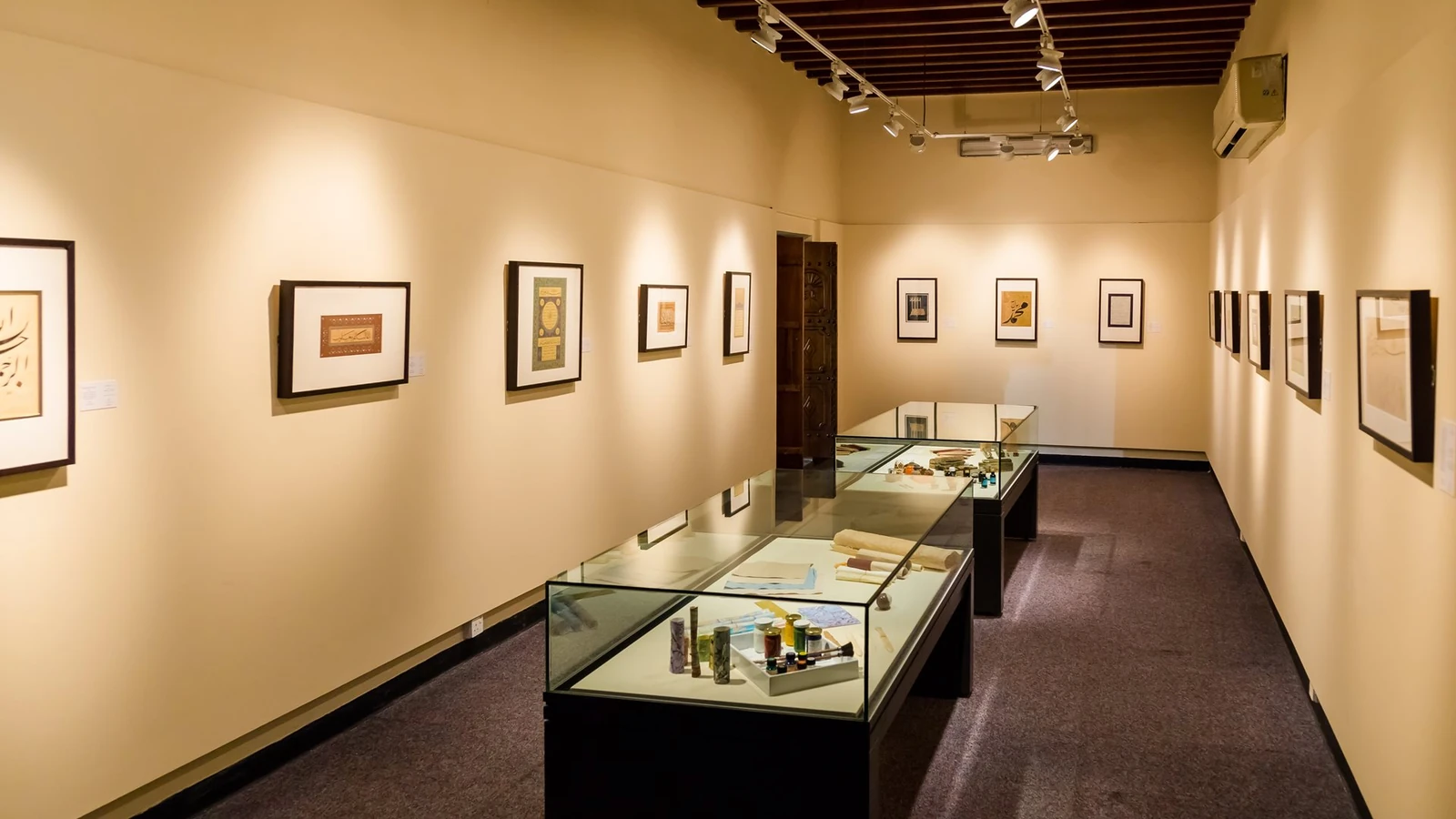
A visitor who cannot read Arabic may assume that a calligraphy museum is inaccessible. A fluent reader may make the opposite mistake: reading the words quickly and overlooking the work of composition. Both can benefit from separating what an inscription says from how an artist has arranged it.
Sharjah Calligraphy Museum offers a focused setting for this enquiry. This guide proposes a practical method for looking, comparing and asking better questions. The suggested exercises are editorial recommendations, not a report of firsthand attendance or a guarantee that a particular work will be displayed. Visitor information was checked against official sources on 10 November 2026, with admission and booking checks set out below.
Understand what the museum is preserving
Sharjah Museums Authority places the museum in the house of Hamad Al Midfa, at Calligraphy Square in the Heart of Sharjah. Its institutional account describes work by local and international calligraphers. [1]
This is a useful starting distinction: a museum can preserve objects while also helping visitors understand a continuing practice. The finished composition is visible; the training, repetition, corrections and judgement behind it are less immediately obvious. Look for information about the maker, medium, date and context before deciding what a work represents.
For a wider discussion of objects and historical interpretation, our guide to Sharjah Museum of Islamic Civilization offers a complementary approach. The institutions should not be treated as substitutes: a focused calligraphy visit allows sustained attention to choices that a broader historical collection may place within a larger narrative.
UNESCO recognition concerns the practice
Arabic calligraphy was inscribed in 2021 on UNESCO's Representative List of the Intangible Cultural Heritage of Humanity through a multinational nomination that included the UAE. UNESCO describes knowledge transmitted through formal and informal learning, with traditional and contemporary materials and applications. [2]
That recognition concerns the practice and its transmission. It does not mean that this museum building is a UNESCO World Heritage Site, that every displayed object has a UNESCO designation or that one country owns the tradition. Keep those categories separate when discussing or sharing the visit.
Use a sequence of looking before interpretation
Begin at a distance sufficient to see the whole composition. Notice where your attention lands first and how it moves. Then approach to examine the relationship between larger forms and smaller details. Read the label before assigning a script name, meaning, age or regional origin.
A useful sequence is: observe, identify, interpret and verify. Observation might record a dense central area or an extended horizontal movement. Identification uses the artist's name and the museum's description. Interpretation proposes why those choices matter. Verification asks whether the label or another dependable reference supports the proposal.
| Looking task | Question to ask | Boundary to keep |
|---|---|---|
| Overall composition | Where does my eye enter and travel? | A personal response is not the artist's documented intention |
| Line and proportion | Which marks feel heavy, fine, compressed or extended? | Do not assign a script family from appearance alone |
| Empty areas | How does unused space affect the arrangement? | An apparently empty area is not proof of unfinished work |
| Material and surface | What does the label identify? | Do not guess age or authenticity from colour |
| Text and meaning | Is a translation or explanation available? | An automated translation may miss the composition or context |
| Comparison | Which visible decision changes between two works? | Difference does not automatically establish a hierarchy of quality |
These questions allow a non-specialist to engage seriously without pretending to possess expertise. They also encourage fluent readers to slow down after recognising a phrase.
Compare two works instead of rushing through every wall
Choose two works that appear visibly different and give each a close reading. Select one point of comparison: scale, spacing, density, colour or relationship between text and image. Keeping the question narrow makes the exercise more precise.
For example, you might observe that one composition gives its main form generous surrounding space while another draws your eye through a denser field. That is a defensible description of what you see. A claim that one represents freedom and the other social constraint would need evidence from an artist's statement or curatorial explanation.
Our Sharjah Art Museum guide develops a similar distinction between observation and interpretation for a different collection. Use comparison to refine attention, not to flatten calligraphy and painting into the same discipline.
A hypothetical exercise for a mixed-language family
Imagine a family with one Arabic reader and two people who do not read the language. Each person describes the composition before anyone translates it. The reader then explains only what can confidently be read, distinguishing a literal reading from any interpretation of its significance.
Compare how knowing the text changes the other visitors' attention. Did an area previously treated as a shape become a word? Did the visual rhythm remain interesting after the wording became clearer? This exercise gives each person an active role and avoids making one family member responsible for delivering an improvised lecture.
Ask staff before drawing, using materials or photographing a work. A quiet looking exercise requires no special equipment, and uncertain translations should remain questions rather than captions posted online as fact.
Resolve the admission contradiction before depending on it
The museum's official page currently displays a “Free Entry” heading, but its detailed schedule lists AED10 for adults aged 13 and above, AED5 for children aged 2–12 and free admission below two. It also lists a heritage joint ticket at AED20 for adults and a separate child rate. [1]
Those statements do not establish a single unambiguous tariff. Ask the museum which applies to your date and visitor category. For planning, allow the published single-museum amount rather than promising your group that entry is free. This is a budgeting precaution, not a confirmation of the charge that will be collected.
If comparing a joint ticket, verify its included museums and current conditions before purchase. The museum page and the authority's general FAQ use different names for one school museum in the joint-ticket list. [1][3] Do not assume a name change, additional entitlement or identical package without checking.
The financial decision should follow the itinerary. Buying access to more venues makes sense only when the group can realistically visit them. A discount that creates pressure to rush can reduce the value of the cultural day.
Plan the route, timing and access together
The published ordinary hours are Saturday–Thursday, 8am–8pm, and Friday, 4pm–8pm. Ramadan and holiday arrangements differ. [1][3] Check the actual date rather than carrying these hours forward unchanged into a special period.
The authority's general FAQ says ordinary individual visits do not require advance booking, while organised categories such as school and tourist groups do. It also allows personal photography but directs publishing and project use to its permission process. [3] Buying a ticket does not itself grant publication rights over the artwork or exhibition photographs.
For access needs, ask about the entrance, circulation route, seating and any assistance that must be arranged. A general facilities statement cannot answer whether a particular visitor can complete the planned journey comfortably. Describe the requirement concretely instead of asking only whether the museum is “accessible”.
Allow time outside the galleries for arrival, orientation and a pause. If linking the museum to another stop, check the actual route and the group's willingness to walk, especially when carrying bags or travelling with children. A compact-looking map does not describe comfort, shade or fatigue.
Put calligraphy within a wider Sharjah day
A useful cultural itinerary can combine a focused artwork visit with a different type of attention. After close looking indoors, a public-space or heritage visit may provide a change of pace. The second stop should answer another question rather than merely increase the number of attractions completed.
Sharjah Art Foundation offers a separate introduction to approaching contemporary art and programmes. Check its current locations and schedule independently; cultural institutions sharing an emirate do not necessarily share admission arrangements or operating hours.
For families wanting a different sensory art experience on another occasion, our Sharjah Rain Room guide explains the importance of session booking and visitor suitability. It should not be added casually to the same plan without confirming availability and transfer time.
Questions that make a visit more useful
Do I need to read Arabic to benefit?
No. Begin with visible composition and the information supplied by the museum. Ask for clarification where the wording matters. Enjoyment does not require pretending to translate or identify every script.
Should I identify the script from a phone image?
Treat an image search or automated answer as a lead, not a settled attribution. Consult the label and ask staff. A confident but incorrect classification can prevent you from noticing what the work actually presents.
Can I photograph a work and use it in a publication?
Personal photography and publishing permission are different questions. Follow the authority's stated permission route for publication or project use, and respect any more specific restriction applying to a work.
What is the best thing to take away?
Take one clearly described comparison and one question for further study. A sentence explaining a visible choice is more useful than an unsupported claim that a work is ancient, sacred or the best example of a tradition.
Official sources and editorial method
Sources checked on 10 November 2026. Numbered references support the official facts stated. Planning frameworks and hypothetical scenarios are CYUAE editorial analysis, not individual legal or tax advice. Photographs are contextual; image credits identify their source and licence. They do not document a particular application or case.