
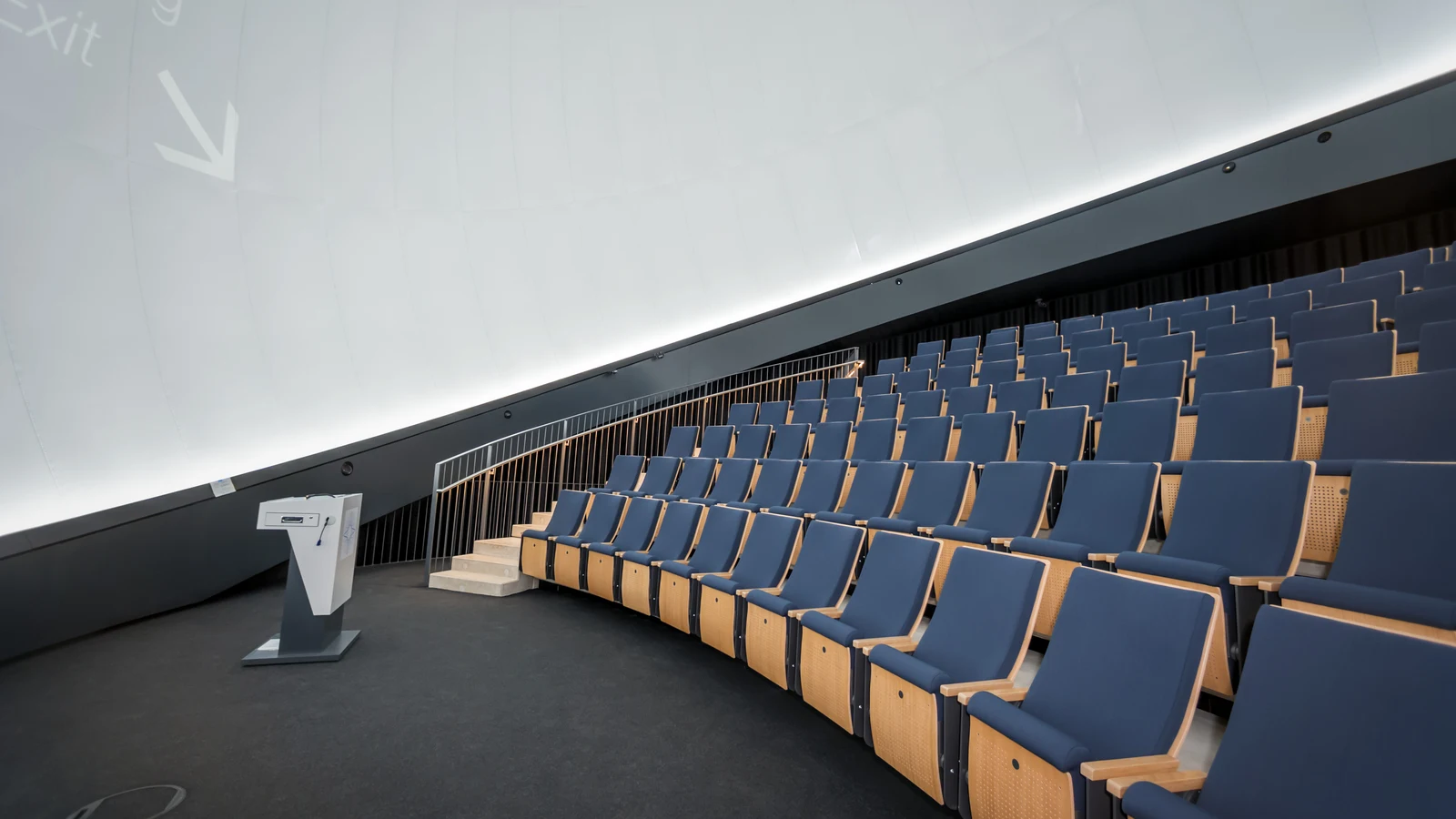
A planetarium visit works best when the family agrees on what it is going to experience. A projected journey through the sky, a scientific exhibition and an observation through a telescope are different activities. Booking one should not create an expectation that all three are included. The useful preparation is to identify the selected programme, confirm who can attend and arrive with a small number of questions worth exploring.
Sharjah's planetarium is part of the University of Sharjah's astronomy and space-science institution. The university publishes a show schedule and an individual-reservation route, while Sharjah's tourism authority describes the destination's exhibitions and simulation-based learning.[1][2][3] This guide was checked on 7 November 2026. Its learning exercises and hypothetical family plan are CYUAE editorial suggestions, rather than a programme promised by the institution.
Separate the dome show from the exhibition visit
The individual-registration terms make an important distinction: children under four are not permitted inside the planetarium, although they can enter the exhibition without a ticket charge under the stated terms.[2] A parent should therefore describe the whole group before paying, rather than assuming that an exhibition arrangement also admits a younger child to the dome.
Related reference: Choosing a Private School in Sharjah: A Family Decision Framework Beyond Fees and Reputation.
Ask what the selected reservation includes. Is it a particular show, a combination with exhibitions or an activity arranged separately? Confirm the show's language, duration and intended audience. A subject that sounds suitable in an advertising title may still require a level of language or attention that does not suit a particular child.
Do not promise a telescope session unless it has been explicitly confirmed. A planetarium can explain the sky through projection; that does not mean the ticket includes outdoor observing or that weather-dependent observation will happen on demand. Keeping the products separate protects the quality of the experience rather than diminishing it.
| Decision before payment | What to establish | Why it matters |
|---|---|---|
| Programme | Exact show and language | Different content can suit different visitors |
| Group | Ages and any individual access requirements | Exhibition and dome admission are not identical |
| Inclusions | Show, exhibition or separately arranged activity | A broad destination description is not a ticket specification |
| Arrival | Entry point and required arrival time | A timed programme is different from an open-ended walk-in visit |
| Payment | Current price, participant category and terms | An unfinished reservation screen is not a confirmed quote |
Use the current schedule without assuming every date is available
At the source check, the university's show page listed weekday morning and early-afternoon sessions, additional Thursday afternoon and evening sessions, and Saturday–Sunday sessions at 12:30pm, 2:30pm, 4:30pm and 6:30pm.[1] Those published patterns help plan an enquiry; they do not establish remaining seats for a specific date.
Choose the actual date and programme through the official reservation route, then check the information returned for that selection. The unselected registration page displays placeholders, including zero participants and blank dates.[2] Those placeholders should not be interpreted as a completed reservation, sold-out date or a zero-price offer.
Related reference: Sharjah Museum of Islamic Civilization: A Visitor’s Guide to Reading Objects, Ideas and Scientific History.
The university's show page says payments are non-refundable.[1] Read the selected booking's terms before paying, particularly when transport, a school timetable or another attraction depends on the same time slot. If the intended session cannot be confirmed, retain flexibility rather than treating a general timetable as a guaranteed place.
Check the price category rather than copying an old tariff
The university distinguishes adults aged 13 and above from children aged four to 12. The public terms also identify free-entry categories, including people above 60 and people with special needs.[1] Confirm how the applicable category is handled for your booking and whether supporting evidence is required.
No exact ticket price is asserted here because the accessible show and registration text did not establish a complete current tariff. Ask for the amount attached to the selected show, date and participants. The registration terms state that ticket prices include the applicable 5% VAT.[2] An accurate quote is more useful than a precise-looking number copied from an older travel article.
For a group, appoint one person to reconcile the participants and the reservation. A last-minute change in ages or numbers can matter to both admission and price. Keep the confirmation, terms accepted and payment record together, without circulating unnecessary personal information across a large messaging group.
Related reference: Sharjah Art Museum: Plan a Focused Visit to Modern Arab Art, Beyond a Gallery Checklist.
Give the visit a question rather than a long homework list
A useful family question is small enough to remember during the show. For example: “How do the images help us understand a place we cannot visit directly?” Another might be: “Which parts are observations, and which parts are a model or visual explanation?” Neither requires a child to arrive with specialist knowledge.
Before the visit, ask each person to make one prediction. Someone might expect stars to appear close together; another might expect a planet to look like a familiar photograph. Afterward, compare the prediction with the explanation actually given. The purpose is to expose an assumption and revise it, not to reward whoever already knows the most terminology.
Avoid asking children to copy every fact. A show is a continuous experience, and excessive note-taking can compete with attention. A short conversation immediately afterwards may preserve more understanding than a page of disconnected names written while the next explanation is already unfolding.
Read simulations as explanations with choices
Sharjah's tourism authority describes the planetarium as using high-technology simulations to take visitors through space-related subjects.[3] A valuable viewing habit is to ask what the presentation makes easier to see. It may change scale, viewpoint or the passage of time to explain a relationship. Those choices deserve attention alongside the spectacle.
Related reference: Sharjah Desert Park: Plan a Family Visit Around Natural History, Plants and Conservation.
After a sequence, ask what the image establishes and what question it leaves open. A vivid visual can make an unfamiliar idea memorable, but remembering the image is not always the same as understanding the mechanism. Invite the visitor to explain the idea in ordinary language without relying on the animation being present.
This is an editorial learning method, not a claim that a particular show uses a specific visual technique. Let the actual programme determine the examples. If an explanation is unclear, record the question for staff or later reading rather than filling the gap with a confident guess.
Plan for attention, comfort and differing interests
Describe any sensory, mobility or communication requirement to the institution before booking. Ask about the actual route and programme rather than relying on a broad assurance that the destination is suitable for everyone. Consider seating, movement between spaces, the presentation's sound and lighting, and whether a visitor can leave if necessary.
A mixed-age family may need two different plans. An older child can attend an appropriate show with one adult while a younger child follows a separately confirmed exhibition arrangement with another. That is a hypothetical option to discuss with the institution, not an admission entitlement or a service the venue is obliged to provide.
Leave some time after the programme before the next commitment. Immediate departure for a tightly timed second attraction can remove the best opportunity to ask questions. A modest visit with room for conversation can produce more learning than an itinerary that treats every institution as another photograph to collect.
A hypothetical Saturday visit
Imagine a family with children aged three and nine considering a Saturday afternoon show. The first decision is not which nearby restaurant to book. It is whether the proposed arrangements work for both children, given the under-four planetarium restriction. The family asks about the selected programme and the separate exhibition option before making payment.
They choose one learning question for the older child and one observation task for the younger child, suited to the activities each actually attends. After the visit, each describes one thing noticed and one question still open. The adults avoid turning the older child's account into a test the younger child cannot reasonably complete.
The outcome is not simply that the family visited a scientific venue. It is that the booking matched the participants, the explanation reached the intended audience and the conversation continued after the presentation ended.
Questions visitors commonly ask
Does an exhibition ticket automatically include the planetarium?
Do not assume so. Confirm the actual inclusions, selected programme and participant rules. The university explicitly distinguishes under-four exhibition access from admission to the dome.[2]
Can this guide guarantee a session shown in the timetable?
No. The public schedule is useful planning information; the chosen date's confirmation is the evidence for your arrangement. Check the actual reservation before committing to linked travel plans.
What should we remember afterwards?
Choose one explanation, describe it in your own words and identify one remaining question. That is a more useful record of learning than a list of impressive images whose meaning has already become uncertain.
Official sources and editorial method
Sources checked on 7 November 2026. Numbered references support the official facts stated. Planning frameworks and hypothetical scenarios are CYUAE editorial analysis, not individual legal or tax advice. Photographs are contextual; image credits identify their source and licence. They do not document a particular application or case.