
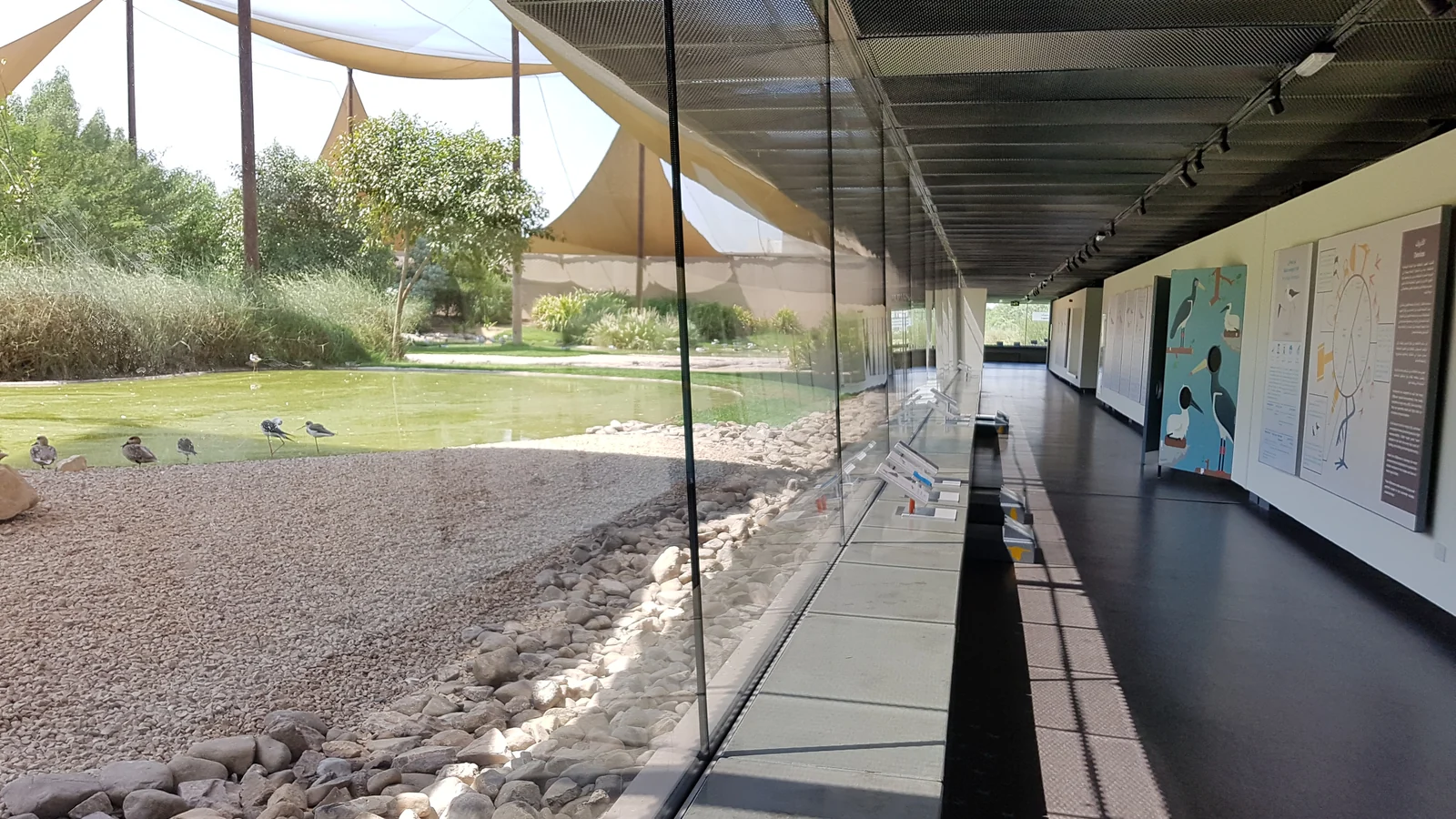
Wasit Wetland Centre gives visitors two ways to see birds. Inside, an observation gallery looks into managed aviaries. Outside, hides face wetland habitat where wild birds come and go. A visit can turn these into one useful comparison. Start by seeing how a bird uses its body to feed or move, then see whether you can recognise the same behaviour at the edge of the lake. You can learn something even when the view is distant or a particular species fails to appear. [1][2]
The centre is in Sharjah's Ramtha area, northeast of the city, according to Visit Sharjah. It sits within a reserve whose habitats include water, mudflat, reeds and dunes. The international Wetland Convention describes the lake as a former tidal lagoon, a remnant that helps explain how the coastline changed. Look at the boundary between land and water as part of the attraction. Much of what birds do happens at that edge. [1][3]
Check what you can actually visit
Visit Sharjah describes exterior hides with binoculars and a golf-cart option for groups and families. Its page says the reserve closes on Sunday, while the UAE Ministry of Climate Change and Environment's ecotourism profile lists daily access and different hours. Call the number in the ministry profile, +971 50 213 3915, to confirm the day's hours, last entry and whether the outdoor route and cart are operating. The ministry lists AED 15 for adults and free entry for children under 12. Confirm current prices and the charge for a child aged 12 or older before setting your budget. Ask separately about those services. A gallery opening time gives you little information about whether a cart will be available or a particular hide can be reached. Ask if you can bring binoculars or borrow them on the day if that affects your plan. [1][4]
For a wheelchair user, a visitor who cannot stand for long or a family with a pushchair, ask staff to describe the route from drop-off to the gallery and from there to the wetland. The architectural record describes a descent into the centre and viewing windows set near the level of the birds. Confirm the practical details that matter to you, including step-free entry, seating, the distance to an open hide and access to a toilet. If you depend on the cart, confirm the boarding arrangement and the return trip. [1][2]
| What you want to learn | Where to begin | What to confirm |
|---|---|---|
| How a bird feeds or moves | Indoor gallery with views into aviaries | Which areas of the gallery are open |
| Where wild birds feed or rest | Open hide facing a wetland edge | Which hide has a useful view and how to reach it |
| How a building changes the view | Entrance descent and gallery windows | Which public route passes those features |
| Whether a short outing works for your group | Reception and one viewing point | Entry, seating, walking distance and return transport |
Start low, then look wider
The centre is part of a wetland rehabilitation project commissioned by Sharjah's Environment and Protected Areas Authority. The Aga Khan Award for Architecture documents the recovery of a former dumping ground and the visitor building completed in 2015. The building, designed by X Architects, received the award in 2019. Its low profile follows the terrain. Visitors descend to the gallery, and the low viewing line helps put birds closer to eye level. Angled glazing and shading address reflection and glare. A clear view across a pane of glass depends on light as much as on the size of the window. [2]
Try a simple comparison in the gallery. Look at the same enclosure from two points along the public route. Notice whether a brighter part of the room reflects across the glass and whether your viewing position changes what you can see on the ground. Then choose one behaviour to follow: a bird holding still, moving repeatedly along an edge or searching in shallow water. Watch where it puts its feet and how it holds its bill. Species identification can wait until you have a useful description of what it did. [2]
The outdoor hide offers a different test. Scan the boundary between open water and reeds, then look for exposed mud or other shallow edges. If several birds gather in one place, check what is shared about that site. It may be shallow enough to stand in, screened from movement or simply where birds have paused. Time at a single viewpoint lets you see whether a bird stays put, feeds actively or moves between habitats. Write down the location and time with any species name. That record will still be useful if you later revise the identification. [3]
The Khor Kalba mangroves guide provides a contrast within Sharjah. Compare the open sightlines of a lake-edge hide with a habitat where roots, channels and tree cover shape what a visitor can see. The Al Zorah mangroves guide adds a nearby coastal wetland in Ajman. Use one comparison at a time, such as where birds stand while feeding or whether foliage obscures the far bank.
A 75-minute example for a first visit
Treat these times as a planning example. A group with young children or people who tire easily can shorten the stop at the hide or spend the full visit in the gallery. Keep outside access as a decision to make when you arrive, after you know which areas are open and how far you need to travel. [1]
- First 10 minutes. Ask which hides are accessible, how long the trip to one takes and how you will get back. Pick a hide based on the site's advice and your group's ability to get there.
- Next 20 minutes. Watch two birds in the gallery. Describe one difference you can see, such as how quickly they move or whether they use shallow water. Ask a staff member about identification if there is an opportunity.
- Next 30 minutes. If the route permits, go to one outdoor viewpoint. Let your eyes adjust before scanning reeds, mud and open water. Record a behaviour or habitat even if you cannot name a bird. If the outdoor route is unavailable, compare how two enclosures offer different feeding or resting areas.
- Last 15 minutes. Return and review your notes. Keep gallery observations separate from wild sightings. Give each identification a confidence level, and note one question you would ask on a repeat visit.
At home, compare the two parts of the record. A close look at a bird using its bill in the gallery may help you recognise a similar motion at a distance. A group that records three wild sightings from two habitats has a more useful account of its visit than a tally that combines the wild and aviary birds without explanation. Changes in light, weather and bird movement also mean two visits can produce different observations. [1][3]
What bird counts tell you about the reserve
Visit Sharjah describes a reserve with more than 200 bird species. The Wetland Convention's designation announcement records at least 144 species in its account of the site, including migratory birds. Those figures reflect different published accounts. They establish the reserve's value as habitat while leaving open what you will see on a specific day. The Convention also records species such as curlew sandpiper and Eurasian curlew. Read those as examples from its record of conservation interest and record any actual sightings separately. [1][3]
The reserve was declared a National Protected Area in 2004 and designated a Wetland of International Importance in 2019. The Convention identifies the Ramsar site as No. 2386, with an area of 86 hectares. The designation describes the ecological site. The centre, gallery and hides provide a way to observe parts of the landscape at the visitor's scale. Fujairah's Wadi Wurayah conservation and access guide is a second example of why status and day-to-day access each need their own check. [2][3]
Can I visit if I am new to birdwatching?
Start in the gallery. Pick a single bird and watch what it does for a few minutes. If you continue outdoors, look for a similar action in the wild. Sharjah's Maritime Museum and Aquarium guide offers a separate way to learn about coastal life through exhibits if your group wants to follow the wetland visit with a different kind of observation. [1][2]
Are the birds behind glass wild sightings?
The architecture record identifies the spaces beside the gallery as aviaries. Keep those observations in a separate part of your notes. A bird seen from a hide using the wetland is a field observation, and you can add time, habitat and behaviour to help interpret it. [1][2]
Is the outdoor circuit essential?
The gallery is a complete goal for a short visit, particularly if you want to study how the building frames views or let a new observer get a closer look at bird behaviour. If seeing wild birds is the main reason for travelling, confirm access to an appropriate hide first. [1][2]
Official sources and editorial method
Sources checked on 14 November 2026. Numbered references support the official facts stated. CYUAE labels hypothetical examples and editorial analysis in the text. The image caption records the photograph’s context, source and licence.
- Visit Sharjah — Wasit Nature Reserve location and visitor facilities ↗
- Aga Khan Award for Architecture archive — Wasit Wetland Centre project record ↗
- Convention on Wetlands — Wasit Nature Reserve designation and habitats ↗
- UAE Ministry of Climate Change and Environment — Wasit ecotourism profile, admission and contact (Arabic) ↗