
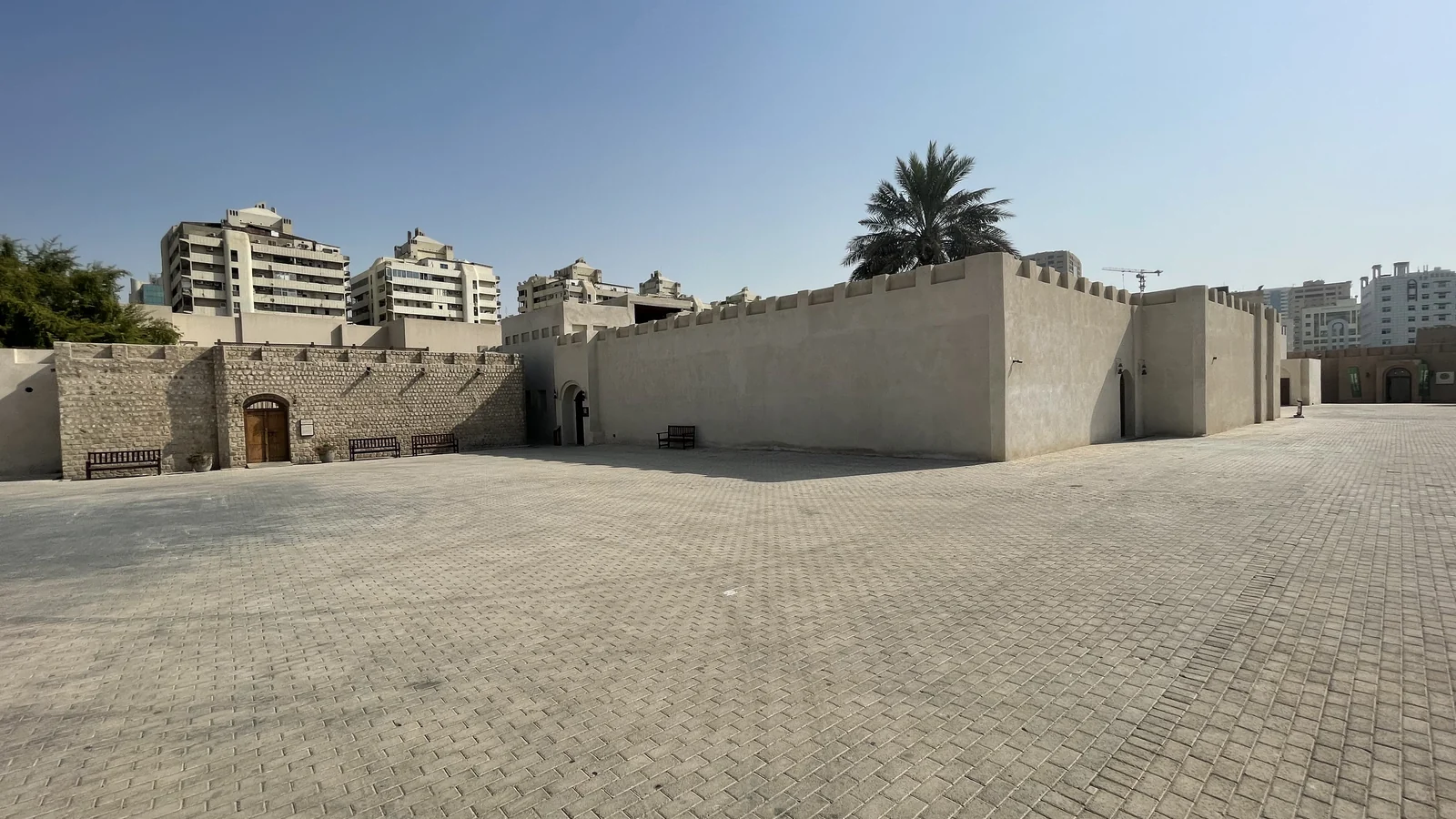
Start your visit at the edge of the courtyard. Look at the wall openings, the teak columns and the doors that lead into the surrounding rooms. Those three details bring together the climate of coastal Sharjah, the way a household used its space and the resources a successful merchant could put into a home. Bait Al Naboodah belonged to pearl merchant Obaid bin Eissa Bin Ali Al Shamsi, known as Al Naboodah. Sharjah Museums Authority dates the house to 1845 and describes how it expanded as the family grew. [1]
Start with the courtyard and follow the air
The two-storey house is arranged around a large central courtyard, with coral used in the walls. Visit Sharjah draws attention to its entrance, carved ornament and wall-mounted wind catchers. From a point where you can look across the courtyard, identify where direct sunlight reaches the floor and where the building creates shade. Then look toward a doorway and consider how conditions change across that short distance. The pattern changes with the hour, so treat your observation as a snapshot. [1][2]
Look up for the malaqaf, the wind scoops set into the walls. The museum distinguishes them from the barjeel, the wind tower often associated with Gulf architecture. This is a distinction you can see in the building itself. A wall opening belongs to the envelope of a particular room or section of the house. A tower projects above the roof and is easier to recognise from farther away. Use the museum's interpretation to identify the openings before guessing how they worked. [1]
The house also rewards a closer look at surfaces. Find a junction between a column, a wall and the roofline from a point where visitors are allowed to stand. Ask which part appears to carry weight, which provides a finish and which has been shaped for decoration. If a label identifies a material, note where it sits in the structure. A sketch with a few arrows often records more about construction than a single wide photograph.
Trace the pearl trade through materials and labour
The museum identifies the merchant's commercial ties with India, Africa and France. It also presents the house as a place where local building practices incorporated wider architectural influences. Think of the connections in two directions. Pearls linked Sharjah to buyers elsewhere. Contact with those markets also gave a merchant household access to goods, materials and designs. A carved teak column makes that relationship tangible. The address of a trading partner, by itself, gives no proof of a particular column's origin. Follow the evidence on the label or ask the museum which parts have documented provenance. [1]
The prominence of the house reflects the position of a successful merchant. To understand how pearls moved through the wider economy, follow an object from one stage to the next. Consider the boat that carried a crew, the work of bringing oysters up, the task of examining what was found and the buyer deciding how much to pay. Each stage calls for different skill and carries a different risk. The Sharjah Maritime Museum guide helps put the household in that wider picture. The Maritime Museum in Al Khan interprets traditional boats, pearling and trade trips. [5]
A comparison with Al Jazirah Al Hamra in Ras Al Khaimah adds another scale of observation. At the Sharjah house, the evidence begins with a single residence and what its owner could commission. In a former coastal settlement, the arrangement of homes, community buildings and lanes gives you a way to think about the industry across a neighbourhood. Both scales help explain where the profits, labour and daily routines of pearling entered the built environment.
Ask what changed when a home became a museum
The authority records that the house became a museum in 1995 and reopened after restoration in 2018. The family had already altered it in stages during its life as a home. When you see a room set up for visitors, ask which parts of the experience are explained by the structure, which by a documented object and which by the way the room is displayed today. A restored surface can show how a technique worked. A room arrangement can help you picture a use that needs to be supported by labels or other records. [1]
Try that approach with a child. Pick a doorway visible from the courtyard and ask them to describe what it does. A door can let people in, screen a view or mark the beginning of a different room. Ask them to point to what supports their answer, then let them choose a different feature and explain it. The museum advertises drop-in activities for children aged 6 to 12 and their families. Ask reception about the materials and instructions available that day. [1]
Plan tickets and access in the Heart of Sharjah
The house is in Al Mareija, opposite Al Arsah Souq. Sharjah Museums Authority lists regular opening hours of 8am to 8pm Saturday through Thursday and 4pm to 8pm Friday. It publishes separate Ramadan hours and holiday closures. Check the museum page or call +971 6 568 1738 before a time-sensitive visit. The authority lists a wheelchair entrance, and its general FAQ says it provides wheelchairs. Ask about steps, thresholds and access to the particular rooms you want to see. [1][2][3]
| Ticket | Under 2 | Ages 2–12 | Age 13 and over |
|---|---|---|---|
| Bait Al Naboodah single admission | Free | AED 5 | AED 10 |
| Heart of Sharjah Heritage Joint Ticket | Free | AED 10 | AED 20 |
These are the museum's published standard prices. The authority lists free single admission for eligible seniors aged 60 and over and people with disabilities, each with one companion, as well as ICOM cardholders. Confirm the applicable rate and any evidence needed. Its FAQ says individual visitors generally need no advance booking, while school, tourist, organisation and VIP groups require it. The dedicated joint-ticket page names the five venues. Ask about validity and opening hours if you plan to split your visit across days. [1][3][4]
Consider two adults and a nine-year-old who have time for the house only. Their standard single-ticket total is AED 25. The joint ticket totals AED 50. If their plans include the Sharjah Calligraphy Museum, which participates in the joint ticket, compare both museums' single prices and decide whether there is realistic time for any third venue. Buying access to five places helps only if the route and available hours suit the group. [1][4]
Build a route around one question
Sharjah Museums Authority allows around 30 minutes for the house in its suggested history tour. Budget more time if you want to read labels closely, sketch the building or join an activity. A self-guided visit might start with ten minutes for the courtyard and entrances, continue with twenty minutes for one group of rooms, and finish with ten minutes to compare notes and ask a question. Give the souq its own time if you want to explore across the street. [2][6]
A second stop can change how you understand the first. Pair the house with calligraphy to compare how craftspeople treat wood and plaster with how artists treat paper and ink. Visit the Maritime Museum on a separate leg for boats and pearls. Our Al Shindagha Museum guide offers another way to compare historic coastal houses and the stories museums tell inside them. Choose one comparison and keep a note of the feature you want to find at each site. [4][5]
Questions before visiting
Can I take photos inside?
The authority's FAQ permits photography and filming for personal use. For publication, research or other project work, consult its photography and filming form and ask staff about local restrictions. If access to a room or a particular angle is important, confirm it before arranging a shoot. [3]
Is the joint ticket necessary to see Bait Al Naboodah?
The house has a single ticket. The joint option covers the house and four other Heart of Sharjah museums. The nearby market and the Maritime Museum in Al Khan are separate stops. Check which venues and admissions are included in the actual ticket you buy. [1][4][5]
What should I look for if I have only half an hour?
Identify the wall scoops, study one carved element and find one label explaining the owner or the building. Those observations give you a route from the climate to the craftsmanship and then to the merchant household. Save the wider story of pearl diving and trading voyages for Al Khan. [1][5][6]
Official sources and editorial method
Sources checked on 12 November 2026. Numbered references support the official facts stated. CYUAE labels hypothetical examples and editorial analysis in the text. The image caption records the photograph’s context, source and licence.
- Sharjah Museums Authority — Bait Al Naboodah history, architecture, hours and fees ↗
- Visit Sharjah — Bait Al Naboodah and the Heart of Sharjah setting ↗
- Sharjah Museums Authority — Booking, wheelchair and photography policies ↗
- Sharjah Museums Authority — Heritage Joint Ticket and participating museums ↗
- Sharjah Museums Authority — Maritime Museum, pearling and trade collections ↗
- Sharjah Museums Authority — Suggested history tour and visit duration ↗