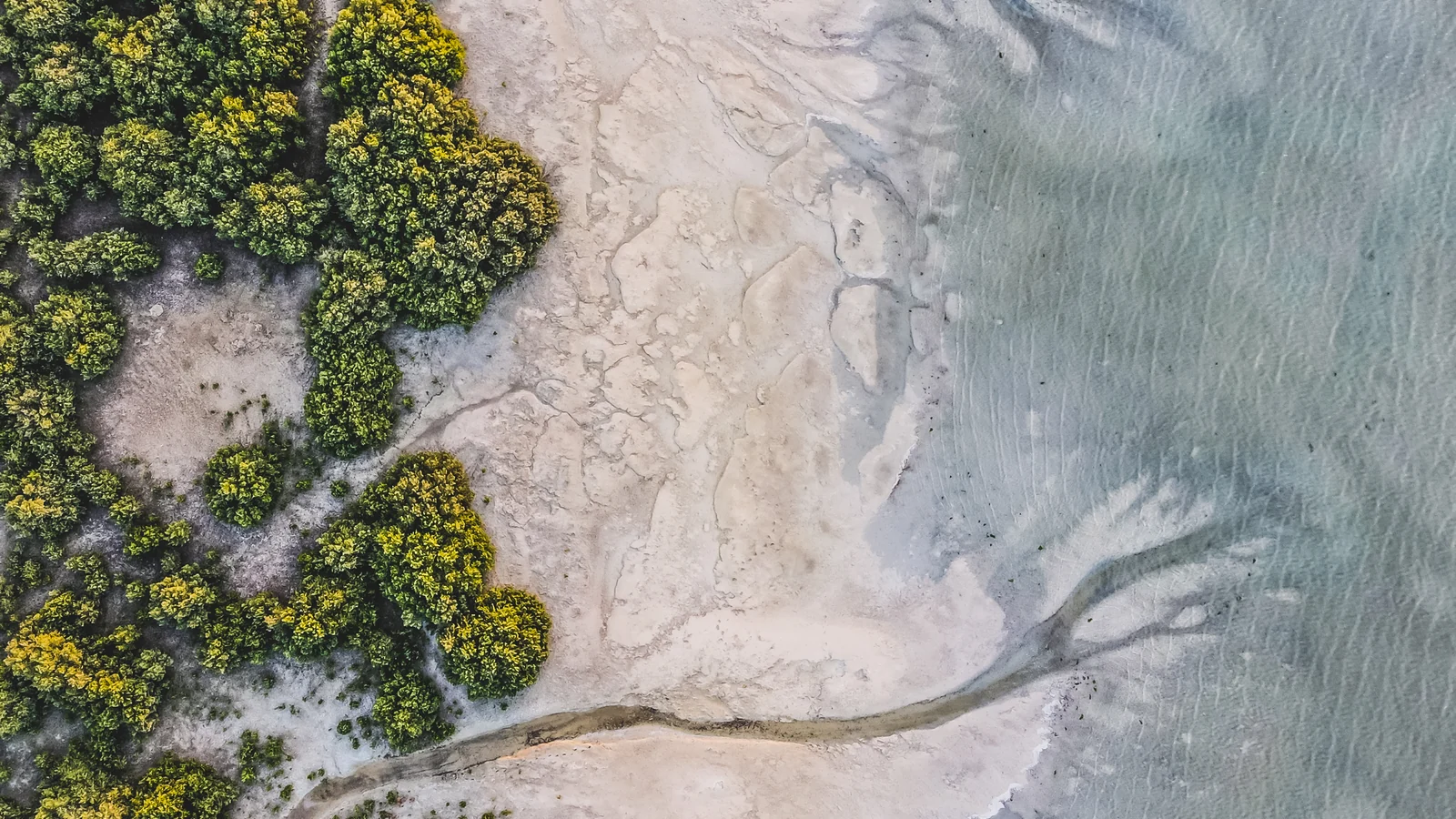
Two discoveries on Al Sinniyah Island help explain how people made a living and organised their communities around the Umm Al Quwain lagoon. One is a church and associated buildings identified by researchers as a Christian monastery. The other is a nearby settlement where shells, pearls and a diving weight show how pearling fit into the local economy. The sites answer different questions. Read them together and the island becomes a place where trade, work and religious life can be studied through buildings and objects. [1][2][3][4]
The island name also appears as Siniya, Sīnīya and Al Sinniya in official and research records. The UAE National Cultural Map lists the monastery, pearling town and Old Umm Al Quwain Town as separate places. Use the specific place name when looking up a discovery, an exhibition or visitor information. A map pin for the island only establishes its location. The condition and access arrangements for an archaeological site need their own confirmation. [1][5]
What made the monastery identifiable?
The 2022 announcement from Umm Al Quwain reported a church and associated rooms, including spaces interpreted as cells, a dining area and cisterns. New York University's field project describes excavation of a seventh- to eighth-century church and associated buildings. The layout matters because different parts of the compound can be studied together. A room on its own might support several uses. A group of spaces next to a church, assigned functions by excavators using the layout and finds, can make a monastic interpretation more persuasive. [2][3]
The cisterns add a practical question to the interpretation. A community needs a way to provision the people who live there. A cistern gives researchers a physical clue about part of that arrangement. The field project's ceramics and glass also put the site in a wider context. The project reports imported vessels and uses material from the excavations to investigate connections across the Gulf and Indian Ocean. Those objects help trace contact through goods. The spaces in which they were excavated help researchers assess what role the goods played in daily life. [2][3]
Compare the monastery with the Ed Dur ancient port guide. Ed Dur belongs to an earlier phase of occupation around the lagoon. It gives you a different site and period from which to ask what trade leaves behind. A fragment of imported pottery can be useful at both places. Its contribution to an interpretation depends on the layer it came from and the buildings and other objects found near it. [2]
How the pearling town was identified
In March 2023, the emirate's Department of Tourism and Archaeology announced excavation findings concerning a pearling town near the monastery. The excavation team's published field report describes a settlement with buildings ranging from larger courtyard structures to tightly packed smaller buildings. It also reports deposits of oyster shells, several pearls and a pearl diver's weight. Together these let the team identify pearling as part of the settlement's economy. The report treats proposed roles for people living in different types of houses as interpretations. [4][6]
The dates published for the town differ. The March 2023 announcement described a period from the late sixth to the middle of the eighth century. The Ministry of Culture's National Cultural Map gives a town profile from the fourth century to the sixth or seventh, and describes several types of buildings, shell deposits and imported storage jars. The excavation report describes the remains in terms of late antiquity and the early Islamic period. For a general visit or reading plan, use that wider description. If you need to cite a narrower date, identify the publication and the specific building, phase or group of finds being dated. The records reviewed here do not resolve the difference between the two published ranges. [4][5][6]
The Akab coastal archaeology guide asks a similar question about a different place in Umm Al Quwain: what does the arrangement of coastal animal remains tell us? Al Sinniyah offers a case where shell deposits can be read alongside the tools and products of a particular activity. Use the sites to compare methods of interpretation across periods, keeping each assemblage in its own archaeological context. [4][6]
| Place | What gives it a distinct story | Useful question before visiting |
|---|---|---|
| Monastery | Church and related structures excavated as part of a compound | Is there an official way to see the site or an interpretation of its plan? |
| Pearling town | Settlement remains and finds connected to the pearling economy | Which finds or excavation photographs are on public display? |
| Old Umm Al Quwain Town | Separate heritage entry used to explain settlement history before the move to the mainland | Does visitor information refer to the island site or the mainland city? |
A practical example of how archaeologists build a case
Imagine a guide describes a deposit of oyster shells from the island. Begin with the narrow observation that people collected or processed oysters at or near the settlement. The shells establish activity, while the reason for gathering them needs more evidence. Add a pearl found in a documented context and a diver's weight of the kind published by the excavation team. Each finding fits one part of the activity. Shells show oysters were processed, pearls establish the product and the weight adds evidence of diving equipment. The location and dating of all three help connect the activity to inhabitants of the town. [6]
Now compare a different claim: a large courtyard house belonged to a merchant. A house plan can show investment in space and invite questions about the owner's means. It takes more evidence to establish an occupation. Look for storage features, imported objects, evidence of trade and how firmly those finds can be connected to the building. The team's report proposes merchant and fisher households as possible interpretations. Keep that wording when explaining the finding to someone else. The Bait Al Naboodah guide offers a useful comparison with a separately documented merchant house in Sharjah, where the named household gives the building a different kind of evidence. [6]
Build a visit around confirmed access
The National Cultural Map provides the local tourism and archaeology department's contact email and phone for the pearling town entry. Contact the department at info.tad@uaqgov.ae or +971 6 765 6665 and ask whether the archaeological sites have public entry on your dates, whether a guide or advance booking is required, and where the official meeting point is. A reported departmental visit for an invited delegation in 2024 shows the site being used for an organised visit. The records reviewed here provide no regular walk-in schedule for the excavations. Confirm which site the response covers, because an arrangement for one part of the island may cover only that location. [5][7]
If a site visit is unavailable, use the Umm Al Quwain National Museum guide to plan a mainland heritage outing. Ask the museum whether it currently displays material or interpretation from Al Sinniyah. Treat its answer as the exhibit plan. Before going, look at the research team's account and choose two questions, such as whether one plan shows the church and water storage together, or how the pearling finds were dated. That preparation gives a family or study group something to compare even if the island finds are unavailable to see in person. [2][5]
Questions readers ask about Al Sinniyah
Was the monastery inside the pearling town?
The department's announcement places the town near the monastery. The project studies the two in relation to each other and published them as nearby sites. When describing the discovery, keep the buildings and finds attached to the location where researchers reported them. [4][6]
Can I say the pearling town was Tawam?
The National Cultural Map presents Tawam as a proposed identification. Use the island and site names for the archaeological remains, and attribute the Tawam identification to the source when discussing it. [5]
Why do some publications spell the island name differently?
The Arabic place name has several English renderings. The National Cultural Map uses Siniya and Al Sinniya, and the excavation paper uses Sīnīya. Search several spellings when looking for original material, then check whether the document refers to the monastery, pearling town or a separate heritage listing. [1][5][6]
Official sources and editorial method
Sources checked on 14 November 2026. Numbered references support the official facts stated. CYUAE labels hypothetical examples and editorial analysis in the text. The image caption records the photograph’s context, source and licence.
- UAE Ministry of Culture — National Cultural Map for Umm Al Quwain ↗
- New York University Archaeohub — Siniya Island Archaeological Project ↗
- Emirates News Agency — Umm Al Quwain monastery discovery announcement ↗
- Emirates News Agency — Umm Al Quwain pearling town discovery announcement ↗
- UAE Ministry of Culture — Pearling Town on Siniya Island profile and contact ↗
- Sīnīya Island Archaeological Project — Published excavations at the pearling town and monastery ↗
- Emirates News Agency — Official delegation visit to Umm Al Quwain archaeological sites ↗