
A larger income can change the appearance of a life before it changes the conditions of that life. The apartment improves. The business becomes busier. More people depend on the next payment. Yet the freedom to refuse a poor agreement, take time away or absorb an unexpected expense can remain surprisingly small.
For readers building a career, household or business in the UAE, that distinction deserves attention. The useful question goes beyond how much money arrives. What does that income allow you to decide, and what have you already promised away before it reaches your account?
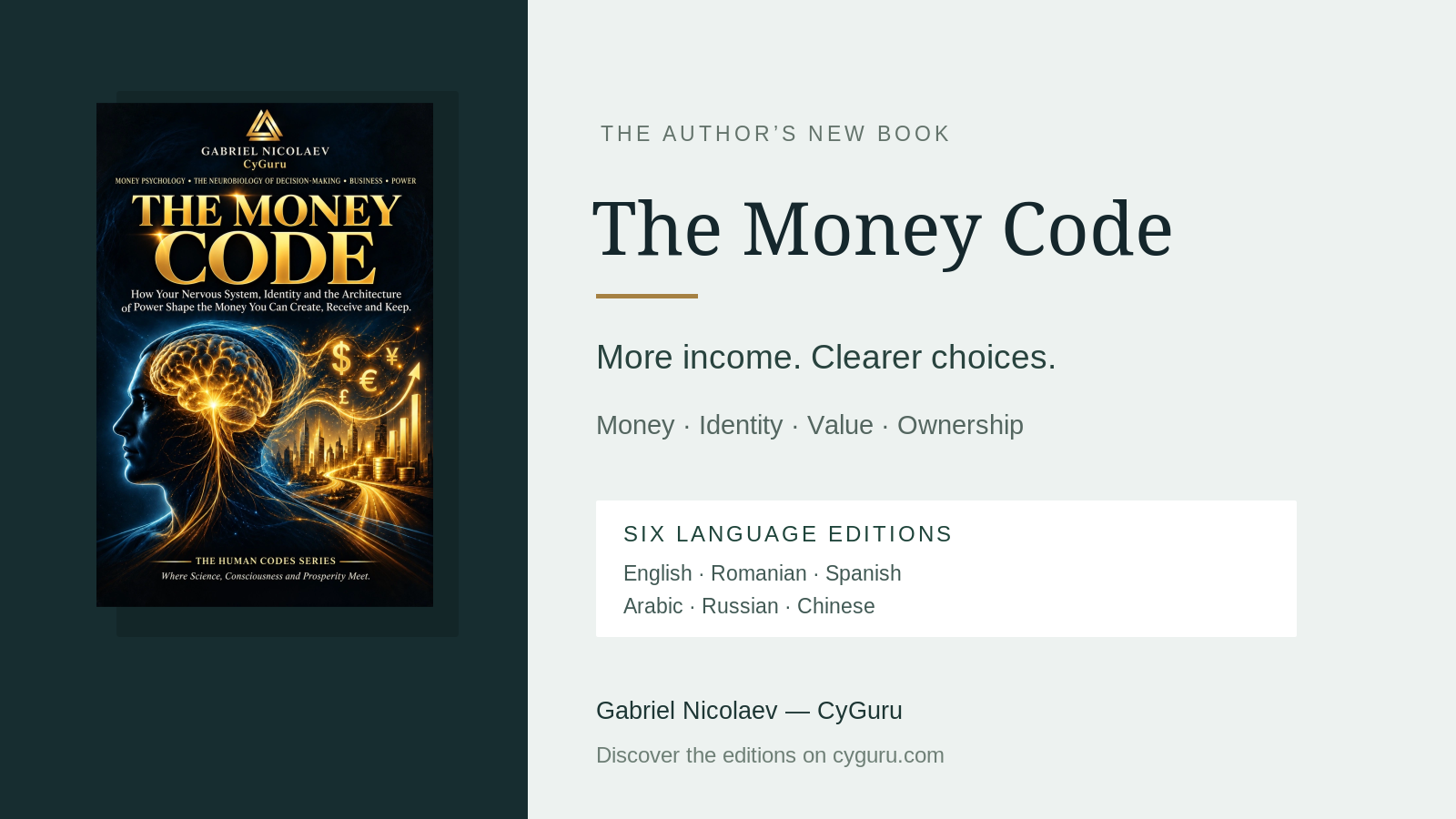
The Money Code, by Gabriel Nicolaev — CyGuru, brings that question into a book presented in six language editions: English, Romanian, Spanish, Arabic, Russian and Chinese. The official catalogue describes forty chapters connecting financial behaviour, identity, value creation, pricing and ownership, with diagnostic questions and practical exercises.[1]
Author disclosure: Gabriel Nicolaev — CyGuru is the author of this book and the author behind CYUAE. This feature introduces his own work and links to his official catalogue. The UAE scenarios below are editorial illustrations, rather than excerpts from the book or accounts of individual clients.
The distinction between earning more and gaining room to choose
Income measures a flow. Freedom depends partly on the obligations attached to that flow. Two people receiving the same monthly amount can have very different options because their fixed costs, commitments, reserves and sources of income differ.
Consider a hypothetical professional whose monthly income increases by AED 6,000. If new recurring commitments absorb AED 5,500, the visible improvement is larger than the improvement in flexibility. Another professional might direct part of the increase toward a reserve and avoid a new fixed obligation. Their lifestyles need not look identical for their financial resilience to differ substantially.
This is an arithmetic example, not a recommended budget. Its purpose is to distinguish an increase in resources from an increase in resources still available for decision. Before celebrating an improved income, examine which choices have become easier and which have become more expensive to change.
For someone planning a move, the first-weeks-in-the-Emirates guide helps organise the practical dependencies. The complementary question raised here is whether the resulting household arrangement leaves enough room to adapt when circumstances change.
Why the six-language editions matter
A financial conversation often changes when it moves from a familiar language into the language of a workplace, lender or commercial agreement. Someone can negotiate professionally in English while discussing family obligations more precisely in Romanian, Arabic, Spanish, Russian or Chinese. Access to a preferred reading language can make a demanding argument easier to examine closely.
The author’s catalogue presents the following six editions and provides language-selection links.[1] Their presence in the catalogue should be distinguished from date-specific retailer availability. At this article’s check, some linked Apple Books pages did not return a readable product listing. Readers should use the catalogue to select an edition and confirm the retailer’s current availability for their region.
| Reading language | Edition listed by the author | Where to begin |
|---|---|---|
| English | English | Official catalogue’s English selection |
| Romanian | Română | Official catalogue’s Romanian selection |
| Spanish | Español | Official catalogue’s Spanish selection |
| Arabic | العربية | Official catalogue’s Arabic selection |
| Russian | Русский | Official catalogue’s Russian selection |
| Chinese | 中文 | Official catalogue’s Chinese selection |
The significance is access. Six editions offer more readers a way into the discussion; the number of languages does not itself establish sales, critical reception or a guaranteed financial outcome. The work still has to earn the reader’s attention through the usefulness of its questions.
Explore The Money Code and choose your language on cyguru.com →
Value creation and bargaining power are separate problems
A person can make an important contribution without controlling the terms on which it is rewarded. A capable employee may avoid negotiating. A founder may deliver excellent work under a price that fails to reflect the service commitment. A specialist may become indispensable while allowing every request to become an unpaid extension of the original assignment.
The book’s official presentation places value creation, pricing and negotiation among its central themes.[1] For a UAE reader, a useful application is to inspect the arrangement through which effort becomes revenue. Who defines the deliverable? Who can change the scope? When is payment due? What happens when the other party delays a decision?
Imagine a hypothetical consultancy charging AED 12,000 for a project initially expected to require forty hours. Revisions and additional meetings increase delivery to eighty hours. Before considering any other cost, the revenue per delivery hour has fallen from AED 300 to AED 150. The invoice value has stayed the same while the economic arrangement has changed.
That example makes a specific problem visible. The next action could be clearer scope, a change-request process or a different pricing structure. Simply asking the owner to work harder would leave the underlying arrangement intact. The Dubai cash-flow, pricing and profitable-growth guide develops this operating distinction in more detail.
Identity can make an expensive arrangement feel necessary
Some financial decisions protect a role before they protect a balance sheet. A person may feel obliged to remain the generous relative, the founder who always says yes, the professional who never discusses money, or the successful expatriate whose appearance must never reveal uncertainty.
These are possible patterns for self-examination, not diagnoses of readers or claims about every household. Their value as questions is practical: what would feel threatened if the spending stopped, the price increased or the obligation was renegotiated?
The Money Code’s presentation connects financial behaviour with identity and emotional pressure. Its subtitle also places the nervous system within the author’s framework.[1] Readers should distinguish that interpretive framework from a clinical assessment. A book’s financial or psychological discussion cannot establish the cause of an individual person’s behaviour merely from an example.
A useful exercise is to take one recurring decision and write two explanations. The first records the financial effect. The second records what the decision seems to preserve socially or personally. If those explanations point in different directions, the next step is a more precise conversation about the trade-off.
Ownership changes what continued effort is required
A salary, a business invoice and income associated with an owned asset have different dependencies. Each can create opportunity, and each can carry obligations. The important question is what must keep happening for the arrangement to remain workable.
For a professional, that may include continued employment and a manageable household cost structure. For a founder, it may include customer retention, collection and the ability to deliver without personally handling every exception. For a property owner, it may include ongoing charges, financing, maintenance and periods without rent.
A headline return cannot answer all those questions. The Dubai net-rental-yield guide separates advertised rent from the costs and cash movements involved in holding a property. The broader lesson is to examine the obligations attached to an asset alongside the income associated with it.
Ownership also concerns control over a working system. A business that depends on the owner’s constant availability may generate revenue while leaving little personal flexibility. A larger operation can therefore require better delegation, clearer responsibilities and more disciplined commitments before it produces a more durable life.
Turn reading into one decision you can inspect
A strong financial idea becomes more useful when attached to an actual choice. Rather than attempting to redesign every part of a household or business at once, select one arrangement and make its consequences visible.
| Decision to examine | What to record | A useful test |
|---|---|---|
| A recurring household commitment | Payment, duration and exit conditions | What flexibility would remain if income changed? |
| A client agreement | Scope, payment timing and change requests | Does the price still match the work being delivered? |
| A property decision | Total holding costs and liquidity needs | Can the arrangement withstand an interruption? |
| A family obligation | Amount, frequency and what has been agreed | Is the commitment clear to everyone involved? |
| A growth plan | Cash required before revenue is collected | Which assumptions must hold for the plan to work? |
This table is a CYUAE reading companion, not a reproduction of a chapter exercise. Use it to select a question, gather the relevant records and identify one change worth considering. A price revision or renegotiated commitment should follow the actual facts and any advice the situation requires.
The cash-poor founder’s timing analysis provides a useful parallel: reported progress and available cash can move differently. Reading becomes more valuable when it helps locate that difference in a real arrangement.
Who will find the book’s questions relevant?
Entrepreneurs may approach the subject through pricing, negotiation and the costs of continual expansion. Professionals may begin with rising income and unchanged financial pressure. Readers supporting family across countries may focus on the boundary between a meaningful obligation and an arrangement nobody has explicitly discussed.
Those are reading perspectives, not promises that one book will solve every financial difficulty. The productive starting point is a concrete question the reader is willing to investigate honestly. What is being earned? What is being retained? Who controls the terms? Which obligations are deliberate, and which continue largely because changing them would be uncomfortable?
The UAE context makes these questions useful across careers, businesses and household transitions. Moving into a larger opportunity should be accompanied by a clearer understanding of what that opportunity will require to sustain.
Discover the edition you want to read
The Money Code offers a way to examine the relationship between contribution, reward and the financial choices that follow. Its six-language presentation broadens access to a discussion that can be personal even when its visible subject is money.
Begin with the official book page, choose the language you want to read and check the current edition and retailer details. Then bring one real financial arrangement to the reading. The most useful result is a sharper decision about how your resources are earned, committed and kept available for the life you intend to build.
Source and publishing information
Book details and six language selections checked against the author’s catalogue on 9 November 2026. Retailer availability can vary by release stage and region. The scenarios, arithmetic examples and reading companion are original CYUAE editorial illustrations.