
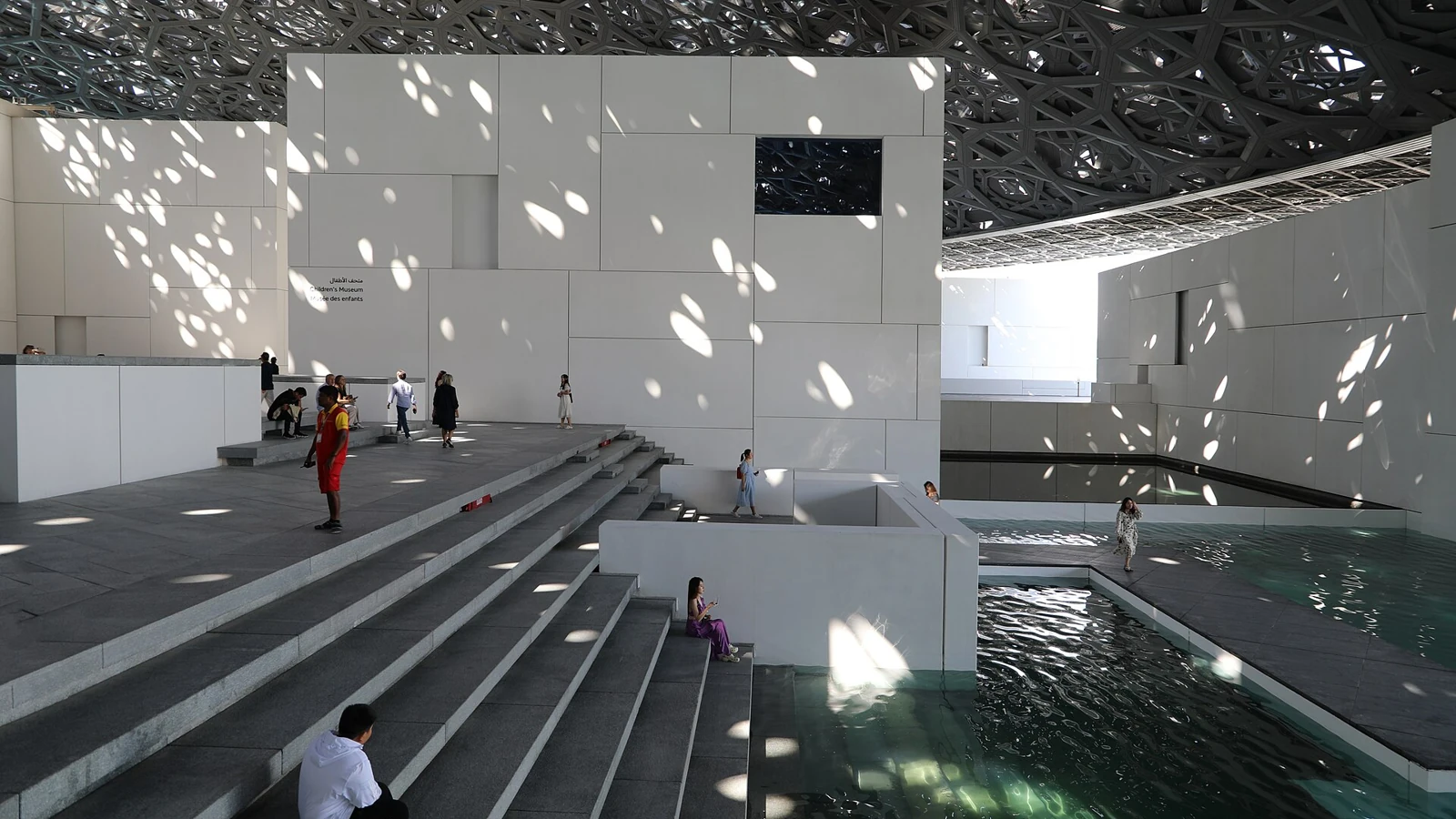
A museum visit can become a sequence of photographs without producing a clear memory of a single object. Louvre Abu Dhabi offers a better opportunity: choose a question, examine a few works carefully, and use the building and collection to think about connections between people who lived in different places and periods.
The museum describes its collection through cross-cultural interactions and artistic expression across time. Its published scope includes archaeological objects, sculpture, painting and contemporary installations.[1] This guide develops a practical method for exploring that proposition. It also addresses a consequential planning problem found during the source check on 9 November 2026: current and older official pages disagree about Monday opening.
Resolve the Monday question before travelling
The current Visit Us page and current English Buy Ticket page list galleries Monday–Thursday from 10am to 6:30pm and Friday–Sunday from 10am to 8:30pm, with last entry 30 minutes before gallery closure. Both give the dome a midnight closing time and 11pm last entry.[2][3]
Older official pages under the longer “visit/plan-your-visit” route still say the museum closes on Mondays. A legacy FAQ address also presents older information, including a different last-entry buffer. The current hyphenated FAQ matches the Monday-inclusive hours.[4][5]
These are differences between live official publications, rather than a reason to assemble a timetable from whichever lines suit an itinerary. Start from the current Visit Us and booking pages, select the actual date, and seek direct confirmation if planning a Monday or arriving close to closing. This matters particularly on the source-check date, Monday 9 November 2026. This article does not establish that a particular session or gallery is available simply because a general timetable lists it.
The practical discipline is to record gallery hours, dome hours and travel arrangements separately. Arriving in time to see the building is different from arriving with enough time to examine the collection.
Choose the ticket and the visit objective together
The current ticket page displays adult admission at AED 70 inclusive of VAT. It lists free categories including under-18s, specified UAE senior nationals and residents above 60, eligible members and pass holders, ICOM/ICOMOS cardholders, journalists, and People of Determination with one companion.[3] Confirm category evidence and the selected product at checkout; a general list does not establish an individual's eligibility.
For a hypothetical group of two adults paying the displayed standard rate, admission totals AED 140 before transport, food or optional activities. That arithmetic is a planning example, not a reservation or a guarantee of current checkout availability.
| Your purpose | What to check before purchase | Planning consequence |
|---|---|---|
| A focused collection visit | Admission inclusions and gallery hours | Preserve enough uninterrupted time indoors |
| Architecture and the dome | Current access conditions and closing times | Do not assume gallery entry follows dome access |
| An organised tour | Tour date, availability and admission requirements | Separate the add-on from the underlying ticket |
| A visit using a concession | Category and supporting documents | Resolve eligibility before travelling |
The Saadiyat Cultural District guide places the museum within a wider cultural itinerary. Here the priority is depth inside one institution, rather than adding more names to the same day.
Build the visit around one question
The following is an editorial viewing method, not an official museum tour. Pick a question that can connect several objects: how do people represent authority, preserve knowledge, organise exchange or express care? A concrete question makes it easier to notice a meaningful comparison without trying to remember every label.
Begin with one object and look before reading. Notice its material, size, condition and the features that attract attention. Then read the label and distinguish what it establishes from what you initially guessed. Was an object made for everyday use, display, ceremony or another purpose? Which details are known, and which remain uncertain?
Next, find a second object that challenges the first interpretation. Similar appearances can conceal different functions; different materials can serve related purposes. The comparison becomes useful when it is specific enough to discuss, rather than reduced to a claim that all cultures are the same.
For a child, the question can be smaller: which object looks difficult to make, or which detail would you miss in a photograph? An answer need not contain specialist terminology to demonstrate close attention. Let the child select an object as well as responding to an adult's choice.
Use a repeatable observation record
A short note can separate three layers: what is visible, what the museum explains, and what you think it may mean. Keeping these apart prevents an attractive interpretation from turning into an invented historical fact.
| Layer | Example of a useful note | What to avoid |
|---|---|---|
| Observation | Material, visible form and a particular detail | Guessing an object's purpose from appearance alone |
| Published explanation | Maker, date range or function stated on the label | Treating an approximate date as an exact year |
| Interpretation | A question about use, influence or social meaning | Attributing motives without supporting evidence |
| Follow-up | A term or context to investigate later | Photographing a label without reading it |
A hypothetical pair of visitors might each choose one object connected with authority, compare their notes, and then look for a work that complicates their first explanation. That is a proposed exercise, not a claim that any particular object is currently on display.
The museum warns that galleries may close while new works are installed.[2] A good plan therefore has a question that can survive a changed route. Avoid making the entire journey depend on an artwork encountered in an old photograph.
Treat the architecture as another form of looking
The official account credits architect Jean Nouvel and relates the building to regional architectural traditions, water, light and the museum's island setting.[1] Those ideas can guide observation without requiring visitors to reproduce a technical architectural analysis.
After the galleries, notice how attention changes beneath the dome. Compare the quality of light, the sense of scale and the movement of other people. Ask what the environment makes easy to notice and what it encourages you to overlook. A photograph captures one instant; returning to the same view after a pause may reveal a different relationship between surfaces and light.
The distinction between architecture and collection also helps a group negotiate different interests. Someone interested in objects and someone drawn mainly to the building can agree on separate periods of attention, followed by a shared comparison. Neither has to turn the other's interest into a rushed detour.
For another day, the Qasr Al Watan guide offers a different architectural and institutional context. A palace and a collection museum should be examined on their own terms.
Prepare the practical journey without overloading it
The current visitor information lists cloakrooms, complimentary wheelchair and stroller loans, interpretation tools and other visitor facilities.[2] Availability of equipment should still be confirmed for an essential access requirement. Ask about the whole route: arrival, screening, movement between spaces, rest opportunities and departure.
The FAQ recommends the museum's free app as a multimedia guide on a personal device and advises bringing headphones. It says food and liquids are not permitted in galleries and explains bag and cloakroom arrangements.[4] Download what you need before arrival and keep the phone from becoming a second itinerary competing with the collection.
For transport, the Abu Dhabi public-transport guide helps separate the journey decision from the museum ticket. Build a return option that remains workable if the group leaves earlier than expected. Do not schedule the final gallery minutes as the only possible departure window.
A hypothetical family itinerary could contain a focused gallery period, a break, and an architectural walk. These are flexible planning blocks, not operator-prescribed durations. Give the break a purpose: ask each person to identify one observation before deciding whether to continue.
Keep photography appropriate to the work and the purpose
Museum visitor regulations explain that some works cannot be photographed or filmed and that restrictions are indicated beside them. Professional photography and filming require approval; the current FAQ also requires written authorisation for commercial recording.[4][6] Check signs and staff instructions rather than assuming every image permitted in one gallery is permitted throughout the museum.
A personal visit should not quietly become a client production. Settle commercial permissions before arranging equipment, participants or deliverables. For ordinary memories, choose a modest photographic target and then put the camera away long enough to examine an object without composing a frame.
Questions to settle before the visit
Is Monday definitely a closure day?
The current canonical visitor and ticket pages list Monday hours, while older official routes still state Monday closure. Use the current booking journey and confirm the intended date with the museum where uncertainty matters.[2][3][5] Do not repeat an older closure rule as if all official pages still agree.
Does dome access mean the galleries remain open?
The current pages publish different closing times for the two experiences. Plan collection viewing around gallery hours, and check the access conditions for any later visit.[2][3]
How can the visit become more than a checklist?
Choose one question, examine a small number of objects, and separate observation from published explanation and interpretation. For a contrasting approach to evidence and place, the Al Ain cultural-landscape guide can support a separate cultural journey.
Official sources and editorial method
Sources checked on 9 November 2026. Numbered references support the official facts stated. Planning frameworks and hypothetical scenarios are CYUAE editorial analysis, not individual legal or tax advice. Photographs are contextual; image credits identify their source and licence. They do not document a particular application or case.
- Louvre Abu Dhabi — Collection, exhibitions and architecture ↗
- Louvre Abu Dhabi — Current Visit Us page, hours and facilities ↗
- Louvre Abu Dhabi — Current English admission-ticket page ↗
- Louvre Abu Dhabi — Current hyphenated visitor FAQ ↗
- Louvre Abu Dhabi — Legacy Plan Your Visit page, conflicting Monday closure wording ↗
- Louvre Abu Dhabi — Published visitor regulations ↗