
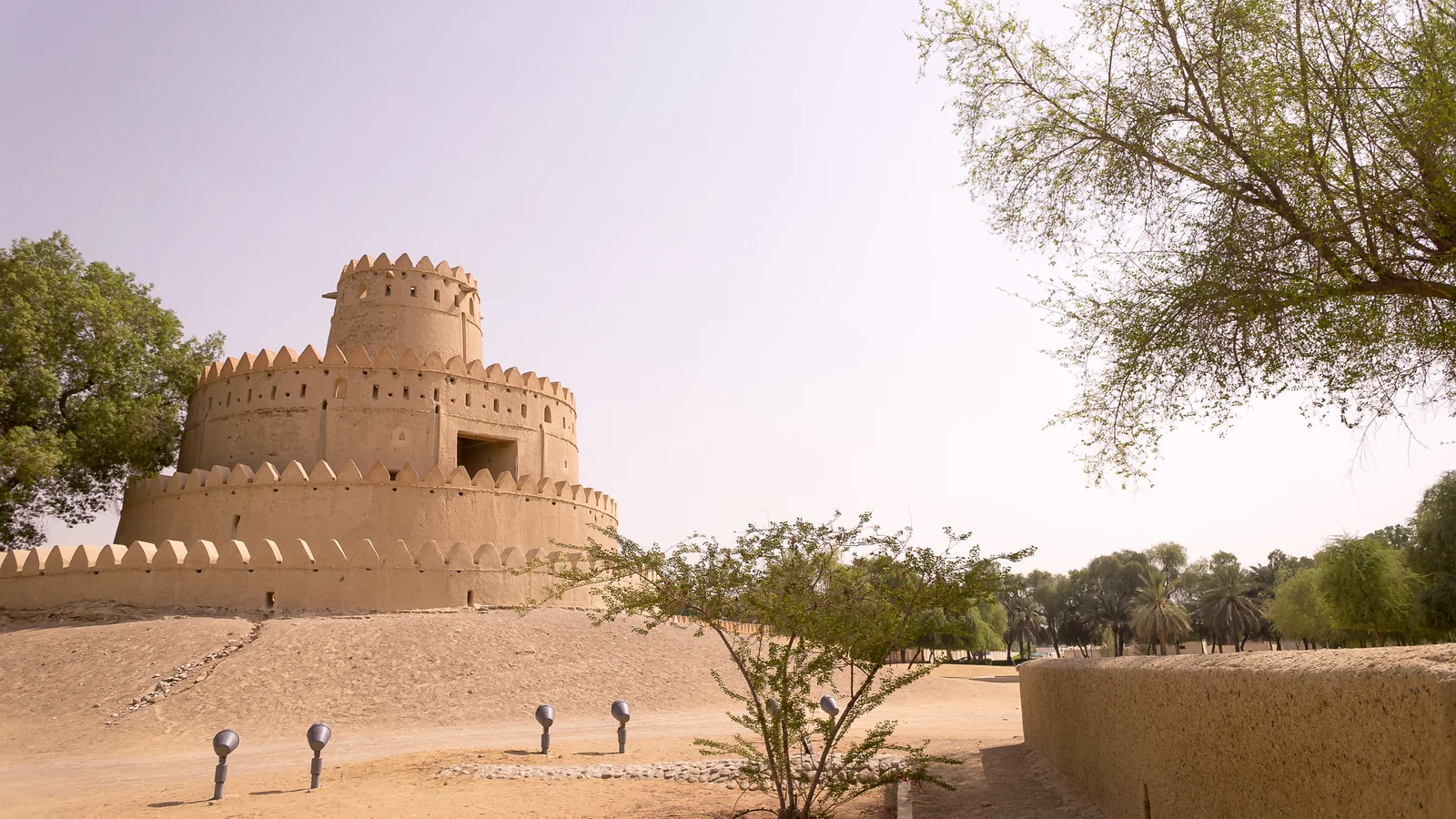
The round tower at Al Jahili is a good place to start reading the fort. From the courtyard you can see how its tiers narrow as they rise, then turn to compare it with the square inner enclosure and the larger compound. The site served as a summer residence, later housed military forces and now contains galleries. Identifying those stages gives you a way to read the walls, gates and rooms before turning to the photographs displayed inside. [1][2]
Check admission, closing time and the route through the fort
Al Jahili Fort is on Mohammed Bin Khalifa Street in Al Ain. Experience Abu Dhabi lists free ordinary entry with no ticket required. Its weekly timetable lists a 9am opening and a 7pm close on most days, with an 8pm Friday close. The Department of Culture and Tourism lists 9am to 7pm daily, and Abu Dhabi Culture's Arabic site lists 9am to 6pm. The public sources disagree on closing time. Plan a daytime visit and call +971 3 711 8311 before relying on late entry or organising around a specific gallery. [3][4][5]
At the entrance, check which spaces are open, where you can sit and whether the sections you plan to see involve steps or uneven thresholds. A useful question is “Which parts of the old fort and galleries can I reach without stairs?” Ask separately about the tower interior if it matters to your visit. Public access to the compound gives you plenty to observe at ground level.
| If your time or access is limited | Make this your first stop | What you can look for |
|---|---|---|
| 25 minutes for the building | A public viewpoint in the large courtyard | The relationship between the round tower, the older fort and the enclosure |
| 45 minutes for building history | The courtyard and the old fort route if open | Differences between the old gate, the larger entrance and the corners of the inner fort |
| 75–90 minutes for history and photography | The fort and the permanent exhibition | A building detail, a historic photograph and the evidence supplied by its caption |
| A visit with limited walking | A route agreed with the visitor team | A level viewpoint and any exhibition spaces reachable on that route |
These are suggested time allowances. Allow additional time for getting from your drop-off point to the entrance. Confirm any temporary restrictions and event admission with the venue.
Separate the old fort from the enclosure you enter today
Sheikh Zayed bin Khalifa Al Nahyan, known as Zayed the First, commissioned the fort. Abu Dhabi Culture dates the work to 1891–1898 and identifies its roles as a summer residence and a place from which to exercise authority. The completion date is recorded on a panel over the old fort's entrance. The site also contains the detached circular watchtower. Documentation prepared for the World Heritage nomination describes it as probably older than the square fort. That difference in certainty is worth carrying into the visit. There is an inscription for the inner fort and an interpretation based on evidence for the tower's earlier history. [1][2][6]
Look for the old square enclosure from a spot where you can distinguish it from the separate tower. Follow the line of the enclosing walls with your eye. How would you move from the open space to a protected room? Which corner offers an outward view? Abu Dhabi Culture identifies a majlis, or reception space, in one corner of the old fort. The presence of a place to receive people helps explain how a building with defensive features could also function as a residence and a place of government. [1][2]
The relationship is useful to compare with Qasr Al Hosn in Abu Dhabi city. The official fort booklet compares the layout of Al Jahili's old fort with that of Qasr Al Hosn's earlier fortification. Pay attention to the arrangement of rooms, towers and gates. Similar plans can tell you something about building traditions without requiring the sites to have had identical roles. [2]
Connect the walls to the water that sustained Al Ain
The nomination documentation records remains of a falaj, or irrigation channel, near the fort. It identifies water and nearby settlement as probable factors in the choice of site. A fort could help protect the people and cultivated land that depended on that water. The precise age of the channel and its relationship to the early tower are questions for the archaeological evidence. [2][6]
To follow that idea through the landscape, pair the fort with Al Ain Oasis. Abu Dhabi Culture describes how two main aflaj supply different parts of the oasis. At the fort, observe how the enclosures shape movement. At the oasis, use permitted paths to see how channels and plot boundaries direct water and organise agricultural land. Our Al Ain cultural landscape guide puts those features alongside the other components of the World Heritage property. [6][7]
The Dhayah Fort guide offers an instructive comparison from Ras Al Khaimah. There the viewpoint directs attention to the relationship between a hill and the surrounding cultivated land. At Al Jahili, the old fort, detached tower and large enclosure concentrate that question inside one compound. Use the comparison to ask what each site had to protect and how its terrain affected the answer.
Look for the military, restoration and museum phases
The fort gained military buildings when the Trucial Oman Levies took it into use in the 1950s. DCT places the transfer to the Union Defence Force in 1971. Restoration in 1986–89 created the present large courtyard and added its monumental entrance. The entrance you photograph on arrival and the inscribed gate to the old inner fort belong to different episodes of the site's history. [2][4]
The rehabilitation in 2007–08 adapted later parts of the complex into visitor and exhibition spaces. The official booklet describes a cooling system that runs chilled water through pipes under the mud plaster in the gallery rooms. The existing earthen construction contributes thermal mass and the system supplies extra cooling. The pipes are concealed, so the booklet or on-site interpretation is the evidence for how the rooms work. You can see the finish without being able to deduce the system beneath it. [1][2]
Compare that treatment with another site through the Fujairah Fort and Museum guide. Ask what the current visitor route allows you to infer about the earlier site and which parts need records, excavation or historic photographs to explain. The value of a restored landmark increases when you can connect an observation to the evidence for it.
Give the Thesiger exhibition time for close reading
The fort's permanent exhibition includes black-and-white photographs by British traveller and writer Wilfred Thesiger, known regionally as Mubarak bin London. DCT distinguishes the permanent display from the temporary exhibition space. Ask which exhibitions are available on your date. [1][2][4]
In the permanent display, choose a photograph and read its caption before drawing a conclusion. Note who appears, where the image was taken and whether the caption gives a date or names the people pictured. Then identify one detail the photograph itself records, such as a load carried on a journey or the way people are arranged in a meeting. That detail and its caption can lead to different questions about the same moment. Think about whose perspective the camera provides and what another participant might have recorded.
For a hypothetical 80-minute visit, allow ten minutes to orient yourself, thirty to compare gates and enclosures, thirty for a small number of photographs and ten for questions. If part of the fort is closed, spend the architecture time on the view of the tower and inner fort from a public area, then use the booklet to follow the missing section. Keep the oasis as a second stop if you have time to look at a channel or plot boundary. [2][7]
Questions before visiting
Who built Al Jahili Fort?
Abu Dhabi Culture identifies Sheikh Zayed bin Khalifa Al Nahyan, known as Zayed the First, as its patron and dates construction of the fort to 1891–1898. The detached tower may predate the inner fort. [1][2][6]
Can I visit Al Jahili Fort and Al Ain Oasis on the same day?
Both are in Al Ain. Plan them as two visits and confirm each opening window, entrance and route independently. If you have only an hour, give that hour to the place that answers your main question. [3][7]
Are there rooms to see if the tower interior is closed?
Ask which galleries and parts of the old fort are accessible. The visitor area and exhibition wings have a different role from the tower, and the courtyard offers exterior views where open. Confirm the route directly if a particular room is central to your plan. [2][4]
Official sources and editorial method
Sources checked on 12 November 2026. Numbered references support the official facts stated. CYUAE labels hypothetical examples and editorial analysis in the text. The image caption records the photograph’s context, source and licence.
- Abu Dhabi Culture — Al Jahili Fort history, construction and visitor facilities ↗
- Department of Culture and Tourism – Abu Dhabi — Al Jahili Fort visitor and conservation booklet ↗
- Experience Abu Dhabi — Fort opening times, location, contact and free ordinary entry ↗
- Department of Culture and Tourism – Abu Dhabi — Fort chronology, galleries and opening hours ↗
- Abu Dhabi Culture — Al Jahili Fort hours and contact, Arabic edition ↗
- UNESCO World Heritage Centre — Al Ain Oasis nomination documentation and Al Jahili Fort evidence ↗
- Abu Dhabi Culture — Al Ain Oases, irrigation channels and visitor information ↗